I just added My own blog List in the left column, and will also say - Come check out Lily's Watercolor Paintings, and Electric Avenue for my next event!
In other thoughts, for those who have not heard of them - there is the very excellent site for people doing and reporting on projects of an Aerodynamic Modification nature: EcoModder.
They are currently listing these projects on their home page:
Streamlining the Civic (2005 Civic EX coupe)
David's 2001 Civic EV (80-100 mile range; 65+ MPH; 8 second 0-60)
CRX HF reverse trike project
Project: The Anal Probe
Aero RV (custom boat tail for '95 Ford E-350 Class C motorhome)
Project Land Yacht (BMW 5-series EV conversion)
Tall tire test (taller gearing advantage offset by wider, heavier wheels/tires?)
AirFlow BulletTruck Project (aerodynamic, modified Class 8 transport doubles MPG)* Nice!
Lean burn Honda Civic sedan: 93 Civic d15z1 swap into LX 4 door (VLX)
Aerodynamic streamline template - online tool (view streamlined extension on any car)
CarBEN EV5 Full Sized Prototype Construction - 5 Seat Electric Car From Scratch
Echo-Troll Modding Thread (2005 Toyota Echo)
and so many more - plus this one -
Project - Extended Pop-Top Aerodynamic Camper Shell ('99 Tacoma)
- Closer than the others to relevance to my project for the AeroCaps!
For full coverage - start right at their home page - EcoModder. That way you won't miss their updates!
Showing posts with label boat tail. Show all posts
Showing posts with label boat tail. Show all posts
Monday, February 4, 2013


Wednesday, December 30, 2009
Boat Tail Mod shows 15% measured improvement!
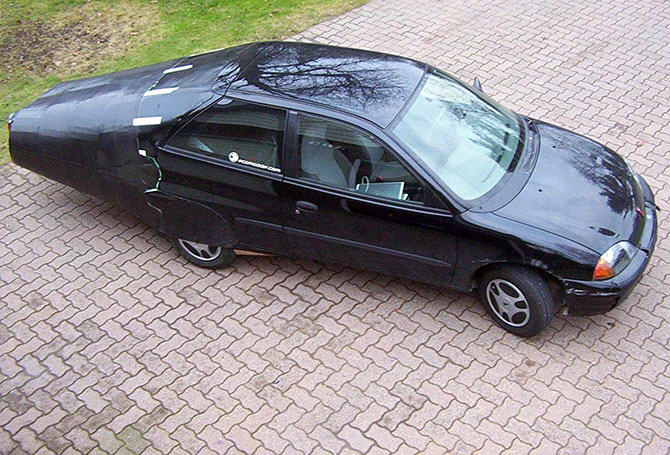 Just a couple days back - there was a recent story: DIY ‘Boat Tail’ Gives Little Car Big Fuel Economy - By Chuck Squatriglia, Autopia, about Darin Cosgrove, an aquaintances Geo Metro Aero Mod package!
His Car - a Pontiac firefly - Like the same one I am using for my Electricfly, but newer, has had simple but practacal testing done - and recorded by Video camera and Tuft Testing to measure flow and turbulence, as well as multiple driving runs to test with mods on and off, to verify the differences, has shown at least a 15% improvement on an already very fuel efficient vehicle.
He Says - “I’ve driven with the tail on for about 300 km in total, mostly at highway speeds up to 100 km/h,” Cosgrove told us. “I didn’t notice any change in handling. The only effect on driving is I have to watch out for rubberneckers in other cars. Seriously.”
The Article mentions "The tail joins the rear wheel skirts, bellypan and other mods he’s made to boost aerodynamic efficiency. The result isn’t much to look at, but it boosted Cosgrove’s fuel efficiency by 15.1 percent at 90 km/hr (56 mph)."
These are all elements to show - that - a vehicle which usually gets below 5 Litre per 100 km, and is now getting below 4 litres per 100 km range - means that's now about one less trip needed to go to the gas station each month or so, so there is a time saving portion to the result as well as a money saving part!
Follow the story to see the Video he posted at the end.
Just think - what would you save if you cleaned up the bottom and rear of your vehicle? Also - if it's done right - you gain a large rear end cruple zone to protect your self and your fellow occupants!
Thursday, November 26, 2009
Boat tail reduces truck fuel consumption by 7.5 percent
On November 5, 2009, Darren Quick put up this post in Gizmag, about how a Boat Tail on a truck saves fuel. Even though it was not smooth and graceful, but rather slab sided and boxy - it still turned in "fuel savings of 7.5 percent".
He goes on to say - "The fuel savings, which also means a cut in emissions, were realized by the boat tail dramatically reducing the drag caused by the lower-pressure effect that occurs in the wake of a vehicle." The key thing is the trailing edge or tail end of the vehicle, is the moree critical aspace for airflow control, and wake managment.
He Shows that these were not just one-off, random tests, but long running hard comparisons, averaged out over time - with various changes to the Boat Tail length: "The lorry was driven for a period of one year with a boat tail of varying lengths and one year without a boat tail. The improved aerodynamics were dependent on the length of the boat tail, with the optimum length found to be two meters (6.5-feet)."
In his story, he also points out the many other aero-structures that Trucks have added to them today to save on fuel: "Trucks already sport a range of modifications designed to improve the aerodynamics of the vehicle, such as side panels, aerodynamic mudguards and mirrors, and roof deflectors. Of these only side panels are more effective at cutting fuel consumption (9 percent) so it’s hard to imagine we won’t be seeing trucks on the roads with a little extra junk on their trunks in the near future."
However - there are a few things I have discovered by attending a presentation at the University of Toronto, on Vehicle Aerodynamics - putting small vortex generators on those cab side panels causes the air to spin up and tighten up the air flow over the gap between cab and trailer that still exists, and cuts the interference drag at this area caused by air trying to escape from between the trailer and the cab, making a new wall of air, so the air stays attached - from cab to trailer.
He goes on to say - "The fuel savings, which also means a cut in emissions, were realized by the boat tail dramatically reducing the drag caused by the lower-pressure effect that occurs in the wake of a vehicle." The key thing is the trailing edge or tail end of the vehicle, is the moree critical aspace for airflow control, and wake managment.
He Shows that these were not just one-off, random tests, but long running hard comparisons, averaged out over time - with various changes to the Boat Tail length: "The lorry was driven for a period of one year with a boat tail of varying lengths and one year without a boat tail. The improved aerodynamics were dependent on the length of the boat tail, with the optimum length found to be two meters (6.5-feet)."
In his story, he also points out the many other aero-structures that Trucks have added to them today to save on fuel: "Trucks already sport a range of modifications designed to improve the aerodynamics of the vehicle, such as side panels, aerodynamic mudguards and mirrors, and roof deflectors. Of these only side panels are more effective at cutting fuel consumption (9 percent) so it’s hard to imagine we won’t be seeing trucks on the roads with a little extra junk on their trunks in the near future."
However - there are a few things I have discovered by attending a presentation at the University of Toronto, on Vehicle Aerodynamics - putting small vortex generators on those cab side panels causes the air to spin up and tighten up the air flow over the gap between cab and trailer that still exists, and cuts the interference drag at this area caused by air trying to escape from between the trailer and the cab, making a new wall of air, so the air stays attached - from cab to trailer.
Subscribe to:
Posts (Atom)


 Posts
Posts


